

For thousands of years, the gods, heroes and monsters of Greek mythology have captured imaginations.
Their stories have been carved into stone, painted across canvases, performed on stages and retold on the page. Yet even after centuries of storytelling, there are still new ways to journey to Mount Olympus.
And sometimes, all you have to do is listen.
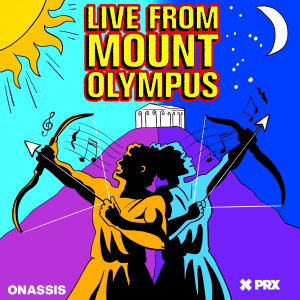
Live From Mount Olympus transforms the legendary tales of Greek mythology into an immersive audio experience filled with larger-than-life characters, theatrical performances, original music and all of the drama one would expect when gods and mortals collide.
Created by Julie Burstein and presented by the Onassis Foundation, the acclaimed podcast has taken listeners alongside figures including Perseus, Persephone, Atalanta, Theseus and Ariadne. Now, its latest adventure turns toward one of mythology’s most famous sibling relationships: the divine twins Apollo and Artemis.
But this time, the gods aren’t only telling their stories.
They’re singing them.
BSCKids: I’m Mira from BSCKids, and thank you so much for taking the time to speak with us today. Live From Mount Olympus is such a unique and immersive storytelling experience. How did the project first originate, and what initially drew you toward it?
Julie Burstein (Live from Mount Olympus creator, producer and showrunner): When I was growing up, my mother often read D’Aulaires’ Book of Greek Myths to me, and I adored the stories and illustrations so much that I can still picture the project I created in 6th grade inspired by those images, a diorama of all the gods sitting on their thrones on Mount Olympus. And a few years ago, a friend who teaches 7th grade told me her students are always asking her when they will get to read the Greek myths. So when The Onassis Foundation asked me to create a podcast for them, drawing on Greek culture and history, I knew that these exciting, powerful stories would make a great podcast series for middle school listeners.
BSCKids: Live From Mount Olympus takes the rich world of Greek mythology and transforms it into something deeply engaging and emotionally resonant for modern audiences. What continues to draw you toward these grand and legendary stories?
Julie Burstein: Once upon a time, the Greek myths helped us understand the world and our place within it. They still do! These timeless tales touch something really deep in us, they delve into challenges that continue to resonate – what a joy to get to tell these stories for listeners today: about gods and heroes struggling for self-discovery and independence; the complexities of relationships between children and parents, between siblings, between friends; the quest to bridge different worlds.
BSCKids: Podcasting is such a powerful storytelling medium and allows for so much creativity and imagination. What made you want to tell these stories through audio storytelling specifically?
Julie Burstein: You’ve put your finger on it – audio allows us as listeners to enter the story and to really be co-creators with what we’re hearing, we get to make up the pictures ourselves! It was incredibly exciting to create mythological audio dramas with the fabulous actors and directors from The TEAM, and to create a rich and mysterious mythical world with sound effects and original music by Magdalini Giannikou (Banda Magda). And this year, to have the gods sing!
BSCKids: We would love to dive a bit more into the production side of the series as well. What is the process like, from start to finish, when developing an episode of Live From Mount Olympus?
Julie Burstein:We begin each season by choosing the myth we’re going to present, and then our team does a lot of research into the most ancient sources. We have advisors who know so much about ancient Greece and the myths who help us as we put together an outline of what each episode will explore. Then I work closely with our writer, the playwright Nathan Yungerberg, to develop the characters and story line. Once we have a draft, director Rachel Chavkin (who won a Tony Award for directing Hadestown on Broadway) reads the scripts and gives us notes.
When the scripts are ready, we sit down with all of the actors for what’s called a “table read,” where they get the chance to read through their parts for the first time and we go through the entire season at one time. The table read gives us a lot of important information about how the story is unfolding, the actors let us know where it’s working and where it may need some tweaks. Nathan and I take tons of notes, and revise revise revise.
Then it’s time to go into the studio in New York City – we record at The Power Station, which was built inside an actual power station! It has an incredible history, everyone from David Bowie to Madonna to Bruce Springsteen has recorded there. The actors really get into their roles, and many of them have told me it is some of the most fun they’ve had as performers – to convey their characters using just their voices. I think the actors who play monsters and giants had the most fun. I even got to play a goat on this last season, which was a blast!
Once the scripts were recorded for this season, I edited all the audio and then built the sonic world the gods live in with our audio producer, John Melillo. Our conversations as we figure out the sound effects can be pretty crazy – “What would a Minotaur’s footsteps sound like?” “Do you think Cerberus would bark with each of his 3 heads all at once, or would one bark at a time?” “What would the underworld sound like?” We layer sounds and voices to create our mythical world, and then it’s time for Magda to create music for the episodes. Her score really brings out the emotion of each scene. John completes the mix, blending voices, sound effects, and music to create the immersive finished program.
BSCKids: Throughout the series, Live From Mount Olympus has explored so many iconic figures and stories from Greek mythology. With this season diving into Apollo and Artemis, how do you approach creating your own interpretation of these legendary characters?
Julie Burstein: Over the seasons, we’ve had hero journeys (Perseus, Atalanta, Theseus and Ariadne) and parent-child drama (Persephone). But for this season I really wanted to dive into sibling relationships – and Artemis and Apollo gave us a fantastic opportunity to do that! The myths themselves give us some clues about their divine twins,with their deep bond and their epic conflicts. Artemis has appeared in many previous seasons of LFMO, so it was fun to go all the way back to her birth to give a sense of how she became the responsible goddess of childbirth as well as the wild goddess of the hunt. Apollo is impulsive and protective from the moment he’s born, chasing after the Python at just four days old because the ancient monster threatened his mother. We used these ancient clues to create a brother and sister who love each other, and also drive each other crazy – a dynamic that will feel familiar to any listener who has a sibling or a really close cousin or friend. Apollo and Artemis’s relationship is at the heart of this season.
BSCKids: This new season also introduces original music into the storytelling for the very first time. How did that creative evolution come together, and what has the process of weaving music into the world of Live From Mount Olympus been like?
Julie Burstein: We have always had original instrumental music, which is such a key element in the storytelling. What is completely different this year is that the gods sing! Our composer Magda Giannikou is a fabulous singer and the leader of Banda Magda – I so clearly remember the first time I heard her music as I was figuring out who should write the score for the series – the moment her infectious song poured out of my speakers, I had to get up and dance! Which made her the perfect composer for the gods. Magda brought in Malena Marcase to write the lyrics. Creating songs for the gods was really challenging and totally the right thing to do – Apollo is the god of music after all! I had never created a musical before, and it was hard and fun and magical. When we began imagining this season, I asked Rachel Chavkin for advice about how to make a musical because as the director of Hadestown on Broadway she is definitely the master of musicals! Rachel told me that characters should sing when they can’t express their emotions any other way. The stories of Apollo and Artemis gave us a lot of opportunity for that!
BSCKids: This season truly feels like a major evolution for Live From Mount Olympus. What are you both most excited for listeners to experience this season and even in the future of the series?
Julie Burstein: I am so excited for everyone to hear our gods sing – they have such marvelous voices! And excited for us to go on this journey with Apollo and Artemis, listening as they support each other, become so furious with each other we wonder whether they’ll break apart, and hope that they find their way back to a loving sibling relationship – because the future of Olympus depends on them working as a team.
BSCKids: The talent behind Live From Mount Olympus is truly incredible. The series feels like a celebration of storytelling, performance, and the theatrical spirit that powers it all. As creatives with strong theater backgrounds, what has it been like bringing those talents from the stage into the world of podcasting?
Julie Burstein: We began recording Live from Mount Olympus in the depths of the pandemic, when everyone was stuck at home, so we had to record the first two seasons on cell phones with everyone in their living rooms or bedrooms! I knew we needed an ensemble of actors who had experience working together already, because we had to work through Zoom (like everyone else in the world at that moment). The TEAM has been performing together for 25 years, and the actors were so happy to be able to continue working even when theaters were shut down. They also brought in young actors from the Epic Theater Ensemble, which has been working with high school students in New York City for 25 years. Christina Liberus, who plays Artemis, began in our first season as Andromeda when she was just 18 years old! I still remember our first recording session, seeing all the amazing actors in little boxes on my screen, when Broadway legend André De Shields (who plays our host Hermes, god of storytellers, travelers and thieves and is currently on Broadway playing Old Deuteronomy in the Tony Award-winning musical Cats, directed by our co-director Zhailon Levingston!) started us off by leading us in an acting exercise where everyone buzzes their lips through musical scales – hilarious and also a great way to warm up voices, even over Zoom. We were all so happy to be working while the world was shut down, and creating a fabulous mythical world our listeners could escape to while our world felt so hemmed in. And I want to acknowledge our incredible illustrator, Jason Adam Katzenstein, too – his delightful drawings of the gods add so much to our story! Each episode has its own image, and I love all of them.
BSCKids: Theater has always been such a powerful form of storytelling. While creating a stage production and creating a podcast are very different experiences, what similarities do you find between those two worlds creatively?
Julie Burstein: Audio drama has a long and rich history – when radio was invented about 100 years ago, one of the first things that was presented on the BBC in Britain was Shakespeare! I think the deepest similarity is the way both stage and audio allow the audience to engage with the story and the characters. As I watched the directors work with our performers, I could see that that on stage or in sound, we’re all focused on the experience of the audience, working to create that magical suspension of disbelief so a listener is carried into an entirely new world.
BSCKids: How has theater, and the way the stage approaches storytelling, helped shape the overall direction and identity of Live From Mount Olympus?
Julie Burstein: Working with playwright Nathan Yungerberg and directors Rachel Chavkin, Zhailon Levingston, Keenan Tyler Oliphant, and Josiah Davis was such a powerful experience – they and the actors brought the best of theater to our audio drama. I loved listening as the directors and actors created the characters and brought the words on the page to life. The project is deeper and richer because of their artistry.
BSCKids: Live From Mount Olympus beautifully blends the heart of live theater, the timeless power of mythology, and immersive audio storytelling. What continues to inspire you both to create stories on this stage and others?
Julie Burstein: I am so inspired by how joyful the process was creating this series. Everyone engaged with the project with their whole hearts and magnificent talents, and I think that joy comes right through the speakers when you listen to Live from Mount Olympus. I’ve worked in radio and podcasting for a very long time, and this was the most fun I’ve ever had. I’m so grateful to our amazing team!
BSCKids: Live From Mount Olympus has already made such a meaningful impact with listeners and families alike. What do you hope audiences take away after each episode ends — and even in the days that follow?
Julie Burstein: This season, I hope listeners will be humming our tunes! And I hope that the stories open up conversations, I’ve heard from families that they love listening together in the car and then discussing the characters and the challenges they face. Like all good tales, these myths give us a lot to talk about!
BSCKids: As we wrap up, are there any final messages you would like to share with fans of Live From Mount Olympus and our readers at BSCKids?
Julie Burstein: I think Hermes says it best at the end of this season – keep telling the gods’ stories! And then make sure to tell your own – there are so many stories to tell!
Stories have a remarkable way of surviving.
Thousands of years separate us from the earliest tellings of the Greek myths, yet we continue to return to them. We still recognize ourselves in their heroes, their families, their conflicts and even their gods.
Perhaps that is part of the magic behind Live From Mount Olympus.
Through performance, music and the limitless possibilities of audio storytelling, these ancient myths aren’t simply being preserved. They’re being retold for another generation of listeners who may one day carry those stories forward themselves.
And as Julie Burstein reminds us through the words of Hermes, there are always more stories waiting to be told — including our own.
We would like to extend our sincere thanks to Julie Burstein for taking the time to speak with BSCKids and for giving us a glimpse behind the curtain of Live From Mount Olympus.
Be sure to listen to Live From Mount Olympus wherever you consume your podcasts.
The gods have told their stories.
Now, what story will you tell?
Facebook
Twitter
Google+
YouTube
RSS